


If you’ve started researching USDA loans, you’ve probably noticed something right away: The rules can seem a little unclear at first.
Between income limits, rural maps, and credit requirements, it’s easy to assume these loans are complicated or available only to a small group of buyers.
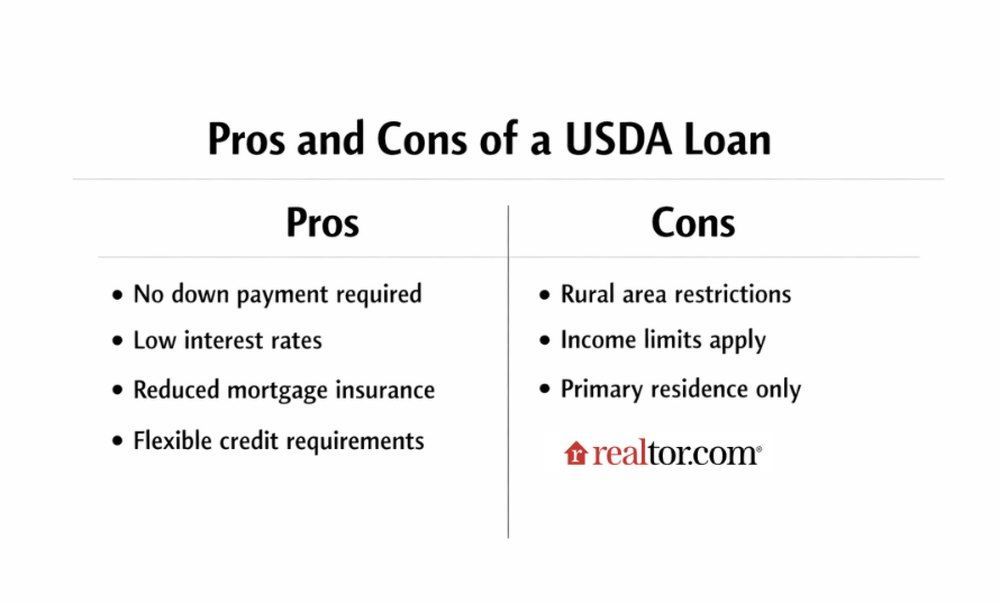
But the reality is much simpler—and more flexible—than many people expect. USDA loans are designed to help moderate- and lower-income buyers achieve homeownership with affordable financing options, including no down payment requirements for eligible borrowers.
And despite the name, these loans aren’t limited to farms or remote countryside homes.
What is a USDA loan and who is it for?
A USDA loan is a government-backed mortgage program created by the U.S. Department of Agriculture to help eligible buyers purchase homes in qualifying areas. The program is designed to make homeownership more accessible, especially for buyers in smaller towns, suburban communities, and rural areas where affordable financing options may be limited.
One important rule applies across the board: The home must be your primary residence. USDA loans can’t be used to purchase vacation homes, rental properties, or investment real estate.
There are two main USDA loan programs:
- USDA Guaranteed Loans: The most common option. These loans are issued by approved lenders and backed by the USDA.
- USDA Direct Loans: Offered directly through the USDA for lower-income borrowers who meet stricter eligibility guidelines.
Most homebuyers researching USDA financing will likely be looking at the Guaranteed loan program because more borrowers qualify for this type of USDA loan.
The 4 main USDA loan requirements
At a high level, USDA loans focus on four major areas:
| Requirement | What It Means |
| Income | Your household income must fall within local USDA limits for your household size. |
| Location | The home must be in an eligible USDA area. |
| Credit | Lenders review your credit history and debt. These requirements may vary by lender. |
| Property use | The home must be your primary residence and meet livability standards. |
Understanding these core categories can make the entire process seem much more manageable.
1. Income requirements
One of the biggest parts of USDA loan eligibility is income.
USDA loans are intended for moderate- and lower-income households, so the program sets income caps based on where you live and how many people are in your household.
For USDA Guaranteed Loans, household income is generally capped at about 115% of the area median income. Limits vary significantly by location because housing costs and incomes differ across the country.
For 2026, many standard household income limits begin around the following:
- 1–4 person households: $119,850
- 5–8 person households: $158,250
Higher-cost areas may allow higher limits. Borrowers can check current income limits using the USDA’s online eligibility tool or by speaking with a lender familiar with the program.
It’s also important to understand that USDA calculations use household income, not just the income of the borrowers listed on the loan application. For example, income from another working adult in the household counts toward the limit even if they aren’t applying for the mortgage.
The two USDA programs handle income differently:
- Guaranteed Loans are aimed at moderate-income households.
- Direct Loans are intended for lower-income borrowers and usually have stricter income thresholds.
Even with these limits, buyers are often surprised to learn they still qualify. Steady, reliable income tends to matter more than earning a particularly high salary.
Lenders will also review your debt-to-income ratio (DTI), which compares your monthly debts to your gross monthly income. Many lenders look for a DTI around 41% or lower, although exceptions are sometimes possible depending on the full financial picture.
2. Location requirements: What 'rural' really means
One of the most misunderstood USDA loan requirements involves location. Many buyers hear “USDA” and assume the property must sit on farmland or in a remote rural area. In reality, plenty of suburban communities and smaller towns qualify.
USDA eligibility is based on population size and geographic guidelines established by the USDA. Some areas located just outside larger cities may still qualify, even if they don’t seem rural at all.
Both USDA Guaranteed and Direct Loans require the property to be located in an eligible area. The easiest way to check is through the USDA eligibility map, which allows buyers to search addresses directly.
Don’t assume your area doesn’t qualify. You might qualify in areas you wouldn’t expect.
3. Credit score and financial requirements
When it comes to USDA loan credit score expectations, there’s no single number that guarantees approval. For USDA Guaranteed Loans, many lenders use a credit score around 640 as a common credit score minimum because it can streamline parts of the underwriting process. However, some lenders may work with lower scores depending on the borrower’s overall financial profile.
USDA Direct Loans technically do not have an official minimum credit score requirement, although applicants still need to demonstrate an ability and willingness to repay debt.
Compared with conventional loans, USDA financing is often considered more flexible for borrowers who may not have perfect credit histories.
Lenders typically evaluate the following:
- Payment history
- Existing debt obligations
- Credit usage
- Income stability
- Recent financial behavior
A few past credit challenges don’t automatically eliminate your chances. Many buyers qualify after rebuilding credit, paying down debt, or establishing stronger payment habits over time. That said, lenders still want to see that borrowers can comfortably manage monthly mortgage payments.
4. Property restrictions
USDA property requirements are designed to ensure the home is safe, functional, and intended for everyday residential living.
To qualify, the property generally must:
- Serve as your primary residence
- Be safe and livable
- Meet local property standards
- Have adequate access, utilities, and structural condition
USDA loans cannot be used for the following:
- Investment properties
- Vacation homes
- Most income-producing properties
An appraisal is also required to confirm the property value and verify the home meets USDA standards.
In most cases, USDA loans are intended for single-family homes, although limited exceptions may apply in certain situations.
USDA Direct Loans may involve additional property restrictions, including limits related to home size, value, or luxury features. For many buyers, though, the property rules are fairly straightforward: The home should be modest, functional, and suitable as a full-time residence.
How to check your USDA loan eligibility
If you’re wondering whether you meet USDA loan eligibility guidelines, the process can usually be broken into a few simple steps.
Step 1: Check the property location
Start by confirming whether the home you want to buy is located in an eligible USDA area. Many suburban and smaller-town properties qualify, so it’s worth checking even if you aren’t looking in a traditionally rural location.
Step 2: Review your household income
Next, compare your total household income to local USDA income limits. Remember that USDA considers household income, not just the income of the borrowers on the loan. That means if you make $70,000 per year and your partner works part time, making around $30,000 per year, total household income would be $100,000 per year.
Step 3: Talk to a lender
If you’re interested in a USDA Guaranteed Loan, speaking with an experienced lender can help you quickly understand your options and identify any potential issues before you apply. If you’re specifically interested in a USDA Direct Loan, you’ll generally need to work directly with your local USDA Rural Development office.
Step 4: Get pre-approved
Preapproval gives you a clearer picture of:
- Your estimated budget
- Potential monthly payment
- Loan qualification status
- Any additional documentation you may need
Getting pre-approved early can also help strengthen your position when you begin shopping for homes. However, it’s important to work with your lender and real estate agent to get pre-approved on the right timeline. A pre-approval often involves a hard credit check that can affect your credit score, and you want to do this when you are ready to start shopping for homes.
USDA loan requirements vs. other loan options
USDA loans share similarities with other mortgage programs, but there are some important differences worth understanding.
USDA vs. FHA loans
Both USDA and FHA loans are designed to help buyers achieve homeownership with more flexible qualification standards.
However:
- FHA loans require a down payment, often starting at 3.5%.
- USDA loans may offer zero down payment financing for eligible borrowers.
- FHA loans are not limited by property location.
- USDA loans require homes to be in eligible areas.
For buyers who qualify geographically, USDA loans can sometimes offer lower upfront costs.
USDA vs. conventional loans
Conventional loans often require stronger credit profiles and larger down payments, especially for buyers seeking the best rates and terms.
Compared with conventional financing:
- USDA loans offer more flexible credit guidelines
- USDA loans allow no-down-payment options
- Conventional loans offer greater property flexibility
- USDA loans include income limits that conventional loans do not
The trade-off often comes down to flexibility versus affordability. Conventional loans allow buyers to purchase in more locations and property types, while USDA loans can reduce upfront costs for eligible borrowers.
The bottom line
At first glance, USDA loan requirements can seem intimidating. But once you break them down, the program is often far more approachable than buyers expect. The guidelines are designed to help expand access to homeownership, not create unnecessary barriers.
If you’re buying in an eligible area, have steady income, and are looking for a primary residence, a USDA loan may be worth exploring further. The next step is usually simple: Check property eligibility, review income limits, and talk with a lender about your options.
You may be closer to qualifying than you think.